Where CCTV blind spots hide around a home
A practical property walk-through for finding weak camera coverage — approach routes, lighting, reflections and the views that produce usable evidence.
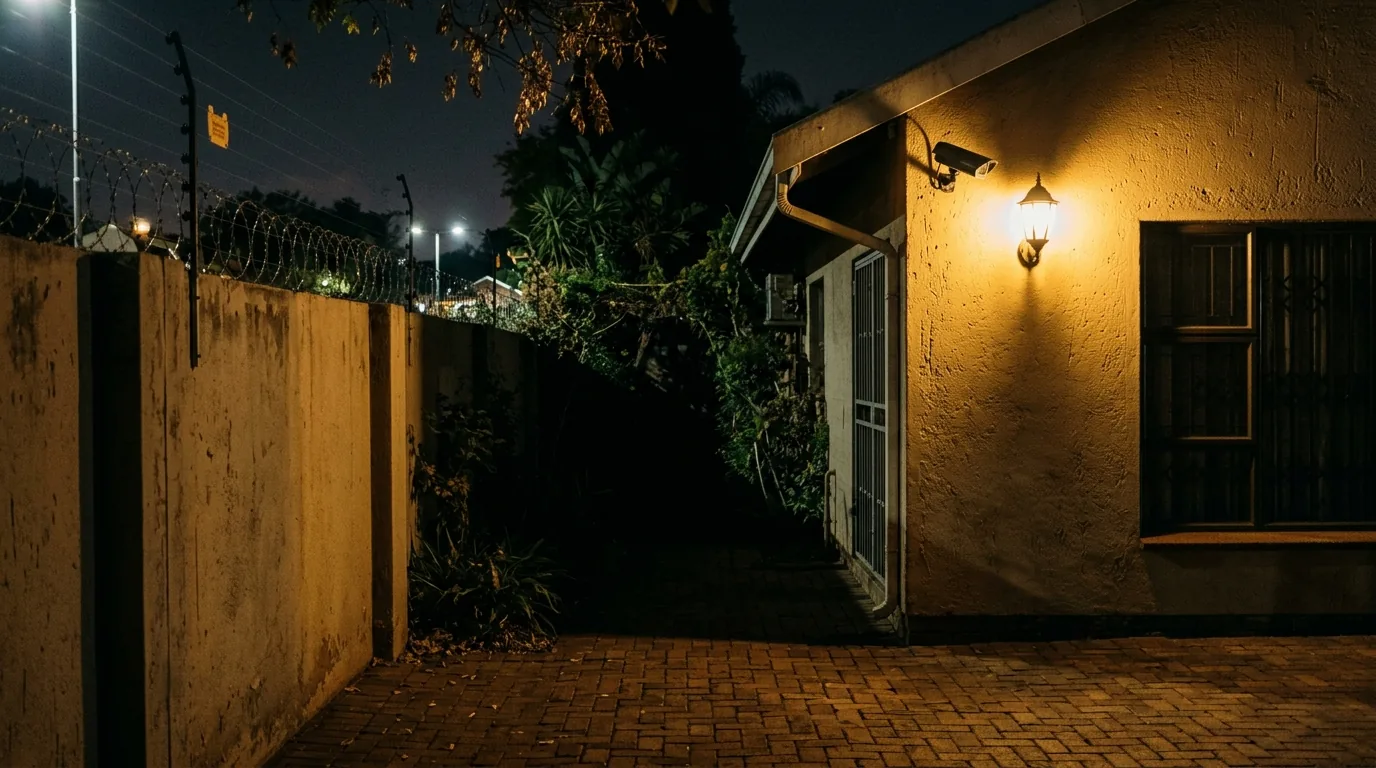
A camera can be technically excellent and still record the wrong thing. Good CCTV planning starts with movement, approach routes, lighting and the evidence a homeowner would actually need after an incident — not with a camera count.
The short version
- Plan around routes people take, not around the corners of the building.
- Walk the property at the time of day the risk is highest, not at 10:00 on a clear morning.
- Infrared reflects off nearby surfaces and can blind a camera at night that looks perfect by day.
- Decide per camera whether you need overview, recognition or identification. One view rarely does all three.
- A system you cannot search quickly has its own kind of blind spot.
Start with routes, not walls
Walk the property as if you were arriving for the first time with bad intent. Note the vehicle entrance, the pedestrian gate, side passages, service areas, and every route from the boundary to a door or window. Those routes matter far more than placing a camera on each corner of the building.
A useful view shows how somebody approached, where they went and what they interacted with. A wide shot establishes movement; a tighter angle is needed where identification matters. Very few single views do both jobs well, which is why camera count tends to be decided by the number of distinct questions you want answered rather than by the size of the house.
- Vehicle and pedestrian entrances.
- Side passages and service yards that are screened from the street.
- Garage, patio and secondary doors.
- Routes hidden by walls, planting or parked vehicles.
- The point where somebody would have to pause — a gate, a lock, a window.
WSN note:The most valuable camera on most properties is not the one watching the front door. It is the one watching the pinch point everybody has to cross to get there.
Check the view at the difficult times
A daytime walk-through does not reveal every problem. Headlights, strong backlighting, deep shadow, rain and infrared reflection can turn a useful image into a silhouette or a bright blur. The intended mounting position should be considered under the lighting conditions the camera will actually face most often.
Two moments are particularly revealing. The first is dusk, when cameras switch between colour and infrared and auto-exposure struggles. The second is the middle of the night with the security lights off, which is the condition many properties are actually in.
Also look for surfaces close to the lens. A wall, roof edge, foliage or an electric fence strand within a metre of the camera will reflect infrared back into it and dominate the night image. The camera keeps recording; the area behind that bright reflection becomes unreadable.
- Dusk and dawn, when exposure and day-night switching are worst.
- Full darkness with security lighting off.
- Headlights sweeping across the frame at the driveway.
- Rain, and the way water on the housing scatters infrared.
- Anything within about a metre of the lens that infrared can bounce off.
Decide what each camera is for
Before choosing hardware, decide what question each camera answers. That single decision does more for the quality of a system than any specification comparison, because it determines lens choice, mounting height and distance.
| View | Question it answers | Typical placement |
|---|---|---|
| Overview | What happened, and in what order? | High, wide lens, covering a whole area |
| Recognition | Was that someone we know? | Mid height, moderate lens, medium distance |
| Identification | Who is this stranger? | Lower, tighter lens, at a pinch point people must cross |
| Plate capture | Which vehicle was that? | Aligned to the approach, dedicated settings, short range |
Design for usable evidence
Think about the questions footage may need to answer. Which direction did a person come from? Was a gate forced or simply left open? Which vehicle entered, and when did it leave? What happened in the ninety seconds before the alarm triggered? Those questions define where overview, recognition and detail views are needed.
Recording also needs a deliberate handover. The owner should know how to find an event, export a clip, and confirm the system time is correct. A system that records good images but cannot be searched quickly creates a different kind of blind spot — one that appears at exactly the moment you are least able to deal with it.
- 01Confirm the recorder date and time are correct, and re-check annually.
- 02Search for a real past event and time how long it takes to find.
- 03Perform a full export to a memory stick before the installer leaves.
- 04Name every camera after the area it covers, in words you would use.
- 05Write down the retention window and diarise a check that it is still being met.
WSN note:Ask to see the expected field of view, not only the camera model. Placement is what turns a specification into evidence.
The blind spots almost every property has
Across residential assessments the same gaps recur, and most of them are caused by mounting cameras where cable is convenient rather than where coverage is needed.
- Directly beneath a high-mounted camera — the cone under the lens.
- The side passage between house and boundary wall, screened from the street.
- Behind a parked vehicle, which changes the scene every day.
- The area a growing tree has quietly taken over since installation.
- The gate itself, viewed from an angle that shows the vehicle but never the driver.
- Anywhere the security light creates a bright pool and everything outside it goes black.
Let the other layers cover what cameras cannot
CCTV is strongest when it works with the rest of the property. Perimeter detection provides the early signal, access control identifies an authorised entry, and the alarm marks the moment worth reviewing. Cameras then supply context and evidence around those events.
That is why a site assessment should treat the property as one protection system. Adding cameras is not always the answer; correcting an approach route, a lighting problem, a gate workflow or an alarm gap often produces a better result for less money.
Common questions
How many CCTV cameras does a home need?
There is no reliable number without seeing the property. The count follows from the number of distinct questions you want answered — approach routes, entrances, pinch points and the level of detail required in each view.
Can one camera cover both a driveway and a face at the gate?
Sometimes, but a single wide view usually sacrifices identification detail. A site assessment should decide whether separate overview and identification views are needed at that point.
Why does my camera look fine by day and useless at night?
Most often infrared reflecting off a surface close to the lens — a wall, roof edge, foliage or fence strand. The camera is still recording; the reflection is dominating the exposure. Re-aiming or moving the camera usually fixes it.
How high should a camera be mounted?
High enough to be out of easy reach, low enough to capture a face. Very high mounting produces a view of the tops of heads, which is why identification views sit lower and tighter than overview cameras.