What CCTV installation really costs in South Africa
A plain breakdown of what drives CCTV pricing in South Africa — cameras, recorder, cabling, storage and labour — and where two quotes quietly differ.
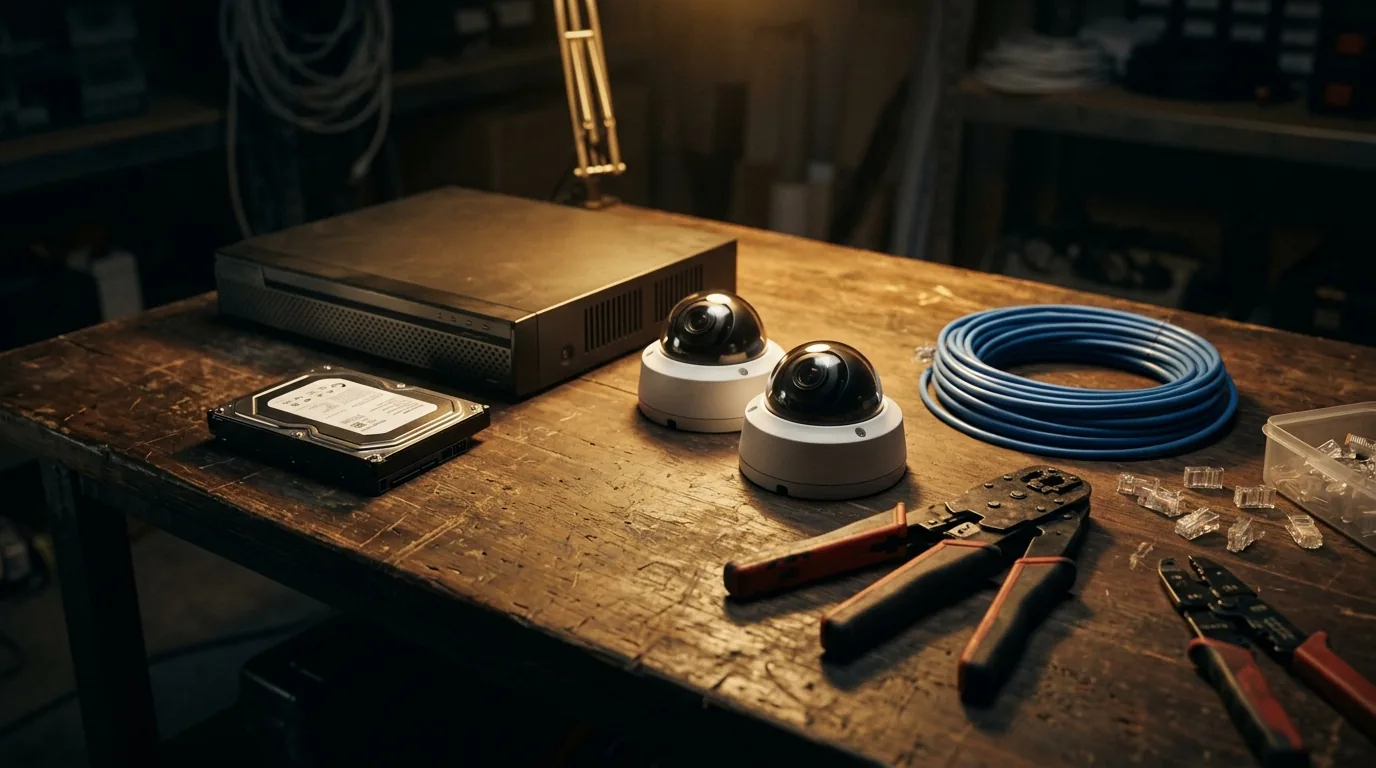
Two quotes for "a four-camera CCTV system" can differ by more than double, and both can be honest. The number is not really a price for cameras — it is a price for a design, a cable route, a recorder, a storage window and the labour to make all of it survive a South African summer. This is what actually sits inside that figure.
The short version
- The camera is rarely the biggest line item — cabling, recorder, storage and labour usually are.
- Resolution alone tells you very little. Lens choice and distance decide whether a face is usable.
- Ask for recording retention in days, not terabytes. Days is the number you care about after an incident.
- A firm price without a site visit is a guess about your cable routes. That guess becomes the extras later.
- Surge protection and backup power are line items, not luxuries, on a South African property.
What you are actually paying for
A CCTV installation is five purchases bundled into one number. Cameras are the visible part. Behind them sit the recorder, the storage, the cabling and power infrastructure, and the labour to install and commission all of it. When two quotes differ sharply, the gap is almost never in the camera brand — it is in how much of the other four the installer intends to do properly.
That matters because the four invisible parts decide whether footage is usable a year from now. A premium camera on a badly routed cable, feeding a recorder with ten days of storage, will lose you the exact clip you needed.
| Component | What it does | Why quotes differ |
|---|---|---|
| Cameras | Capture the image | Sensor size, lens, night technology, IP rating, warranty |
| Recorder (NVR/DVR) | Records, indexes and serves footage | Channel count, AI filtering, spare channels for later |
| Storage | Holds the recording window | Surveillance-rated drives vs desktop drives; days retained |
| Cabling & power | Carries video and power to each point | Cable grade, conduit vs clipped, route difficulty, PoE vs separate supply |
| Labour & commissioning | Design, install, configure, test, hand over | Whether a real design and handover are included at all |
Realistic ranges, and why nobody can quote you over the phone
South African installers work in bands rather than fixed prices, because the same camera count costs very differently on two properties. A single-storey home with an accessible roof void and short cable runs is a fundamentally cheaper job than a double-storey face-brick house where every run is surface-mounted in conduit.
Published market guidance for 2026 puts residential systems across a wide band, with electronic security demand in South Africa growing at roughly ten percent a year and camera pricing under upward pressure. Treat any range you read online — including the framing below — as a way to sanity-check a quote, never as a quote.
- Entry systems: fewer cameras, shorter retention, simple runs, basic night performance.
- Mid systems: full perimeter coverage, AI human and vehicle filtering, longer retention, surge protection.
- High-end and commercial: multi-zone design, identification-grade views, redundant power, documented handover and a maintenance plan.
WSN note:If an installer gives you a firm price before seeing the property, they have priced a guess about your cable routes. That guess is where the surprise extras come from.
The resolution trap
Resolution is the easiest number to market and the least useful one on its own. A 4K camera with a small sensor and a wide lens, mounted high on a corner, can produce a picture in which nobody is identifiable at any distance. A well-chosen 1080p camera at the right height, with the right lens, aimed at a pinch point, can produce a face you could hand to an insurer.
What decides whether footage is useful is pixels-on-target: how many pixels fall across the thing you care about. That is resolution, lens focal length and distance working together. Ask your installer what each camera is for, and let the answer drive the specification.
Night performance deserves the same scrutiny. Infrared gives a monochrome image and struggles with reflective surfaces close to the lens — a wall, a roof edge, an electric fence strand. Low-light colour cameras keep the detail that actually helps a description, the red jacket and the white bakkie, but need a little ambient light to work with. Most properties need a mix of both.
- Overview view: establishes movement and sequence across a wide area.
- Recognition view: enough detail to recognise someone you already know.
- Identification view: enough detail to identify a stranger. Needs a tight, deliberate angle.
- Licence-plate view: a specialist angle and shutter setting. A general-purpose camera will not do it well.
Storage: ask for days, not terabytes
Installers quote storage in terabytes because that is what they buy. Convert it into the only unit that matters after an incident: how far back can I go? Retention depends on camera count, resolution, frame rate, compression and how much motion the scene contains — a camera facing a busy street records far more data than one facing a quiet side passage.
A common disappointment is discovering, two weeks after a break-in that was noticed late, that the system holds ten days. Decide up front how far back you would want to reach, then size the drive for that. Fourteen days is a workable floor for most homes; thirty is a better target for commercial sites and anywhere with deliveries, staff or tenants.
One more thing worth insisting on: surveillance-rated drives. Desktop drives are not built for continuous write cycles, and they fail in exactly the way that loses footage quietly.
WSN note:Write the retention figure into the quote. "14 days minimum across all channels at installed settings" is testable. "2TB" is not.
The two line items South Africans should never cut
Power interruptions, and the surges that follow them, are hard on security electronics. Recorders, cameras and their power supplies sit on the same reticulation as everything else in the house, and the inrush when supply returns is what damages boards and shortens battery life. Surge protection at the supply, plus a properly sized UPS for the recorder, is the difference between a system that survives three years and one that does not.
The second is weather. Highveld summers punish cheap outdoor housings and unsealed connections. Look for a real IP rating on the camera, and ask specifically how cable entries and joints will be sealed. It is a small cost at installation and an expensive one afterwards.
- Surge protection on the supply feeding the recorder and camera power.
- UPS or battery backup sized to hold the recorder and cameras through an outage.
- Sealed, weather-rated joints — not insulation tape in a roof void.
- A documented power-failure behaviour: what does the system do when supply returns?
How to compare two quotes fairly
Put both quotes side by side and normalise them before comparing totals. Most of the time the cheaper quote is cheaper because it excludes something the other includes — usually cabling method, retention, surge protection, or commissioning and handover.
- 01Ask each installer to state the purpose of every camera: overview, recognition, identification or plate capture.
- 02Ask for retention in days at the settings they intend to install, not the drive size.
- 03Ask whether cable is run in conduit or clipped, and who makes good afterwards.
- 04Ask what surge and backup protection is included, and what is explicitly excluded.
- 05Ask what handover includes: camera naming, playback training, an export test and documentation.
- 06Ask what year two looks like: what a service visit costs, and who holds the admin passwords.
WSN note:The password question is worth asking early. A system you cannot administer without calling the installer is a system you do not fully own.
When more cameras is the wrong answer
Cameras record. They do not detect early, they do not deter reliably on their own, and they do not dispatch anybody. If the real gap on a property is that nobody knows something is happening until morning, adding cameras does not close it. Perimeter detection, a properly zoned alarm and a clear response path do.
That is why a good assessment looks at the property as one system: what slows entry, what detects it, what records it, and what happens next. Sometimes the honest recommendation is fewer cameras placed better, plus a beam and a gate fault finally fixed.
Common questions
How much does CCTV installation cost in South Africa?
There is no single figure, because the same camera count costs very differently depending on cable routes, storage retention, night performance and power protection. Market guidance for 2026 spans a wide band for residential systems. The reliable way to get a real number is a site assessment that prices the design, not just the hardware.
Is a 4K camera worth the extra cost?
Only where the extra pixels land on something you care about. Resolution combines with lens choice and distance to decide usable detail. A correctly specified 1080p identification view often outperforms a badly placed 4K overview.
How many days of CCTV footage should I keep?
Fourteen days is a workable minimum for most homes. Thirty days suits commercial sites, complexes and any property where an incident might not be noticed immediately. Specify it in days at installed settings and have it written into the quote.
Can I add cameras to my system later?
Usually, if the recorder was specified with spare channels and the cable routes allow it. Ask at quoting stage whether the recorder has headroom — buying two spare channels now is far cheaper than replacing the recorder in a year.