Why layered security beats disconnected products
How gates, perimeter detection, alarms, CCTV and a defined response work together — and what goes wrong when a property is secured one purchase at a time.
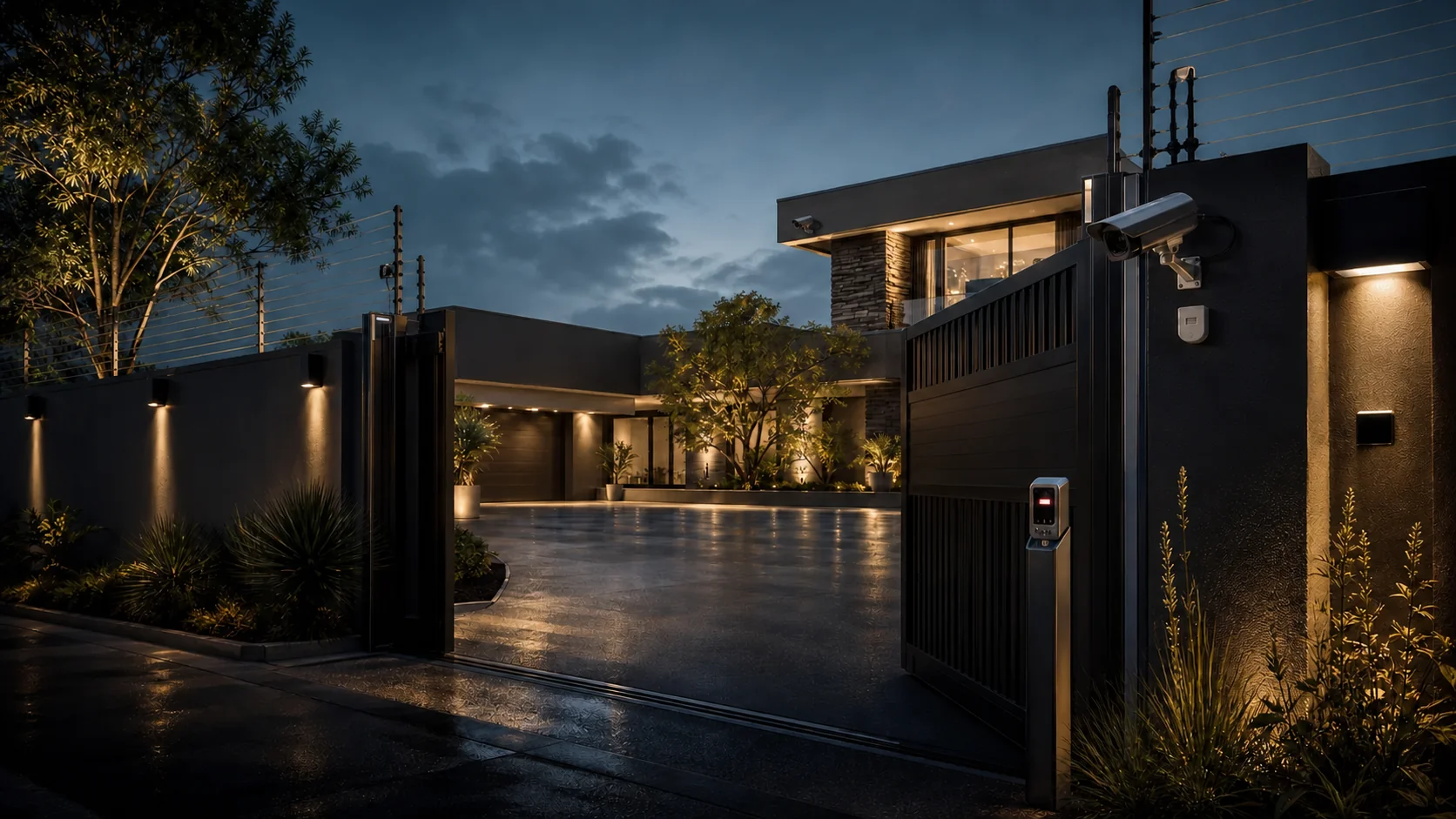
Security products are usually bought one problem at a time. A gate motor is replaced, cameras are added a year later, an alarm is extended when a room is built. Each item works. The property is still left with slow detection, missing context and an unclear response — because nobody ever designed the whole thing.
The short version
- Four layers: control the approach, detect the event, see the context, act on it.
- The weakest layer sets the performance of the system, not the most expensive one.
- Convenience is a security feature. A layer people work around has already failed.
- Naming matters: zones and cameras described the same way make an incident readable.
- Write down what should happen at 02:00. That sentence is your actual security design.
Layer one: control the approach
The boundary and the entrance shape every event that follows. Gates, pedestrian access and electric fencing should make movement deliberate and visible. Their job is not only to form a barrier; it is to reduce the number of uncontrolled routes onto the property so that the remaining routes can be watched properly.
This is also where daily convenience matters most. If a gate, intercom or access process is frustrating, people find workarounds — the pedestrian gate is left unlatched, the code is shared, the gate is left open during the school run. A secure design has to work during deliveries, visitors, contractors and power interruptions, not only during a demonstration.
- Vehicle and pedestrian entrances that latch reliably every time.
- Perimeter that is intact, tensioned and free of climbing aids.
- Access that works for the household as it actually behaves.
- A defined behaviour during power outages — for the gate especially.
WSN note:Every workaround in daily use is a security decision somebody made on your behalf. Design them out rather than asking people to be disciplined.
Layer two: detect the event
An alarm system turns meaningful change into a clear event. Detector choice and placement have to match how the building is used, where pets move, how sunlight and airflow affect rooms, and which areas need protection while people are at home.
Perimeter and internal detection serve different purposes. The first gives you an earlier signal, while there is still a wall between you and the problem. The second confirms movement inside protected space. The value comes from knowing what each zone means and how it should change the response — a beam on the boundary and a passage PIR are not the same news.
- Name zones in plain language, not by number.
- Walk-test every detector during handover, with the owner present.
- Document bypass and stay-mode behaviour so the system can be armed while occupied.
- Make battery and power-failure signals visible to a person, not just to the panel.
Layer three: see the context
CCTV explains what an electronic event cannot. It shows whether movement came from a person, an animal, a vehicle or the weather. It establishes the sequence before and after an alarm, which is often what turns an ambiguous signal into a decision.
For that to work, cameras have to be positioned in relation to the gate, the perimeter and the alarm zones — not as an independent system that happens to be on the same building. When camera names and views match the way the rest of the system is described, finding the right footage takes seconds instead of twenty minutes.
| Layer | Contribution | Without it |
|---|---|---|
| Approach control | Slows and channels entry | Every route is equally available |
| Detection | Marks the moment something changed | You find out in the morning |
| Context | Explains what the signal means | Every alarm is equally ambiguous |
| Response | Turns information into action | Someone has a recording of a loss |
Layer four: make response actionable
A signal only becomes protection when somebody receives enough information to act. Contact details, access instructions, location, live context and escalation steps should not be improvised during an incident, and yet that is exactly what happens on most properties.
The test is simple and uncomfortable: write down, in order, what is meant to happen when the alarm triggers at 02:00 and the first phone call is not answered. If you cannot write it, that is the gap in your security — and no additional hardware closes it.
WSN Guardian is a separate white-label product built for armed-response companies: it structures subscriber alerts, evidence, location and control-room workflow. It is not automatically bundled with a WSN home installation. The two WSN divisions solve different parts of the market, and the reason the platform exists is precisely that this fourth layer is the one most often missing.
- 01Write the 02:00 sequence down, including who is called second and third.
- 02Confirm the response provider has current access details and gate codes.
- 03Decide who in the household can cancel an alarm, and how.
- 04Test the sequence once a year — a real test, not a mental one.
- 05Review it whenever someone moves in, moves out or changes phone number.
The weakest layer sets the outcome
Money in security is usually spent where it is easiest to spend it, which is on the layer that is most visible. Cameras get added because cameras are tangible. Meanwhile the perimeter has a gap behind the garage, the beam has been bypassed for two years, and nobody has confirmed who gets the call when the primary contact is on a flight.
The useful discipline is to spend on the weakest layer rather than deepening the strongest. That is almost never the exciting purchase, and it is almost always the one that changes the outcome.
WSN note:The strongest system is not the one with the most equipment. It is the one whose layers produce a clear, tested sequence from detection to decision.
Integration does not mean one brand
Integration is often sold as a single-vendor requirement. It is not. What matters is that the design, the naming, the handover and the response workflow are consistent, and that the equipment chosen can be maintained by more than one person.
Practical integration on a residential property usually looks modest: the electric fence energiser reported into the alarm panel as its own zone; camera names matching alarm zone names; the gate status visible where the household already looks; and one document that describes all of it. That costs almost nothing and does more than a proprietary ecosystem.
- Fence energiser and tamper reported as alarm zones.
- Camera names mirroring alarm zone names.
- One equipment schedule covering every discipline on the property.
- A maintenance interval that covers the whole system, not one part of it.
Common questions
What should be installed first: an alarm or CCTV?
It depends on the property and the existing equipment. A site assessment should identify whether the immediate gap is detection, evidence, access control or the perimeter. On most properties the earliest gain comes from detection, because it changes how soon anybody knows.
Do integrated systems have to be one brand?
No. What matters is consistent design, naming, handover and response workflow, plus equipment that more than one technician can maintain. Single-vendor ecosystems can help, but they are not the requirement.
Is an electric fence worth it if I already have an alarm and cameras?
Often yes, because it addresses the layer the other two do not: it slows entry at the boundary and, when reported as an alarm zone, produces a signal while somebody is still outside.
How do I know which layer is weakest on my property?
Walk through a realistic incident out loud. Where the story stops making sense — nobody detects it, nobody can tell what happened, nobody is called — is the weakest layer.