What a panic alert should tell your control room
A panic signal says something is wrong. Operators also need where, who, what kind, and what responders should know. A checklist for control room managers.
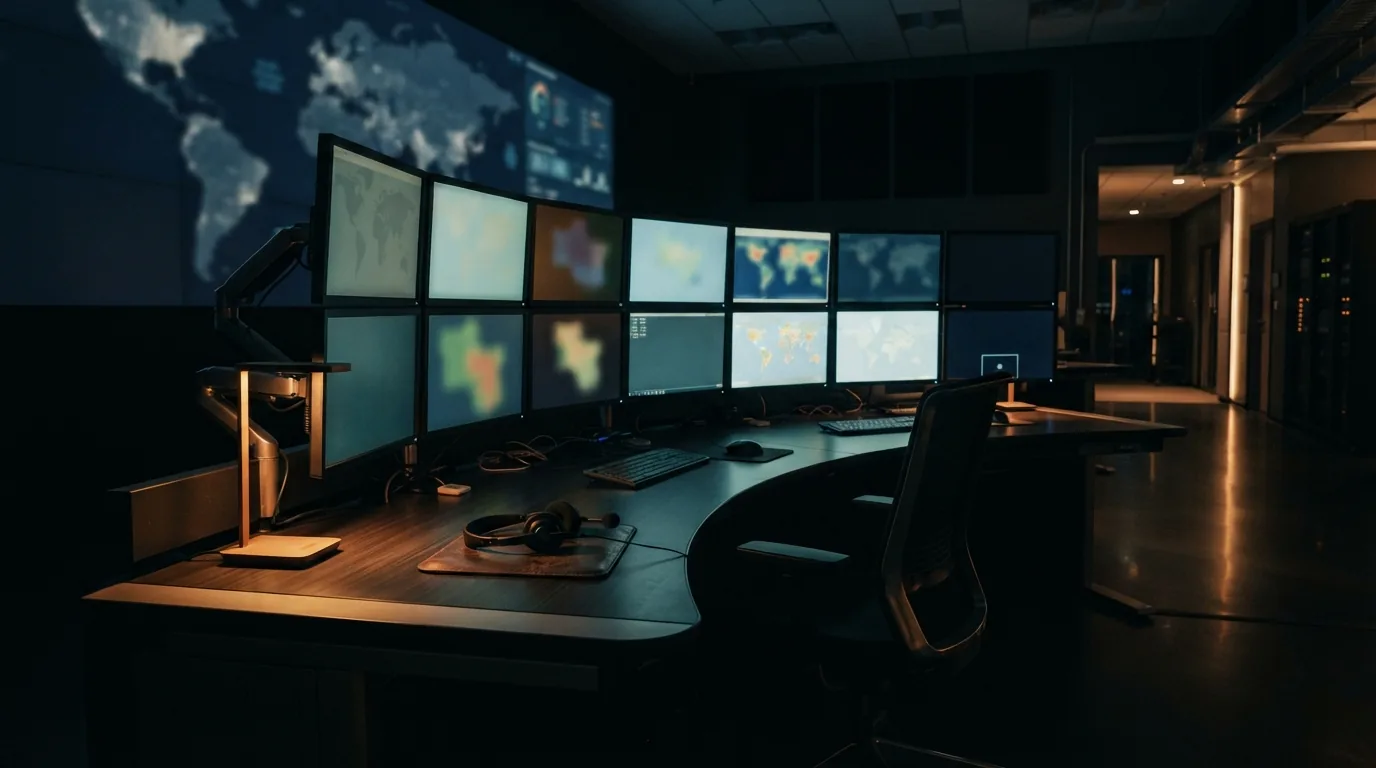
A traditional panic signal carries very little: an account number, perhaps a zone, and the fact that somebody pressed something. Everything else the operator has to find out, usually by phoning the subscriber while a vehicle is already on its way. Every question asked on that call is time the responders do not have, and in some situations the call itself is dangerous.
The short version
- An operator needs four things the moment an alert arrives: where, who, what kind, and what responders should know before they get there.
- Live location matters more than a stored address. People are attacked in cars, at gates and in parking garages, not only at home.
- A verified photo stops responders confronting the wrong person, and a medical record answers the questions a paramedic would otherwise ask.
- Silent alerts need different handling. Calling the subscriber back can tell an attacker that help has been called.
- Every step, from acknowledgement to resolution, should be recorded with the time and the operator’s name.
The problem with a blind alert
Most control room procedures grew up around fixed alarm panels. A signal arrives from a known address, the operator checks the account, phones the subscriber to verify, and dispatches. It is a sensible process for a house. It is a poor one for a person.
People do not only need help at home. They need it at the gate when a car has followed them in, in a parking garage after work, at the side of the road after a crash. A panic signal that resolves to a home address sends responders to the wrong place. A verification call that rings while an attacker is standing beside the subscriber can make things worse.
The fix is not a faster phone call. It is an alert that already carries the answers.
Where: a live position, not a stored address
The first thing an operator needs is where the subscriber is now, and whether they are moving. A phone can supply that: GPS coordinates, an estimate of their accuracy, and a trail as the position updates. The control room can then study the approach on street view or from above before a vehicle arrives.
Movement matters as much as position. A stationary alert at a shopping centre is a different situation from one travelling along a highway, which may be a hijacking or an abduction. Live tracking lets the control room follow the subscriber and redirect responders, rather than chase an address that is already out of date.
- The current position and its accuracy, updating while the incident is open.
- Street view and aerial view to plan the approach.
- Movement over time, so a moving incident can be followed.
- Whether the incident falls inside or outside your service area.
Who: positive identification
Responders arriving at a scene need to know who they are there to protect. In a home invasion or a hijacking several people may be present, and mistaking an attacker for the subscriber, or the subscriber for an attacker, has obvious consequences.
A verified photo on the incident solves this. In Guardian, the photo comes from the subscriber’s own handset and sits on the incident beside their name and account number, so the operator can describe the person to the responding team before they arrive.
What kind of emergency
A panic alert, a medical emergency and a fire need different responses, sometimes from different services. An alert that arrives already labelled lets the operator send the right team first. Guardian’s home screen gives subscribers separate panic, medical and fire buttons, and the control room sees which was pressed.
Some alerts arrive without anyone pressing a button. Crash detection raises one after a hard impact if the subscriber does not cancel a short countdown. Guardian Hold raises one when the subscriber lets go of the screen. A journey that runs past its time escalates on its own. Each should be clearly distinguishable on the operator’s screen, because each implies a different situation.
Priority should be impossible to miss. In Guardian the incident feed is colour-coded, and panic, medical and fire alerts sound an audio alarm that keeps going until an operator acknowledges the incident.
What responders should know before they arrive
A paramedic arriving at a collapse asks the same questions every time: blood type, allergies, chronic conditions, current medication. If the patient cannot answer, the questions go unanswered. If the answers are already on the incident, the operator can pass them on while the team is still driving.
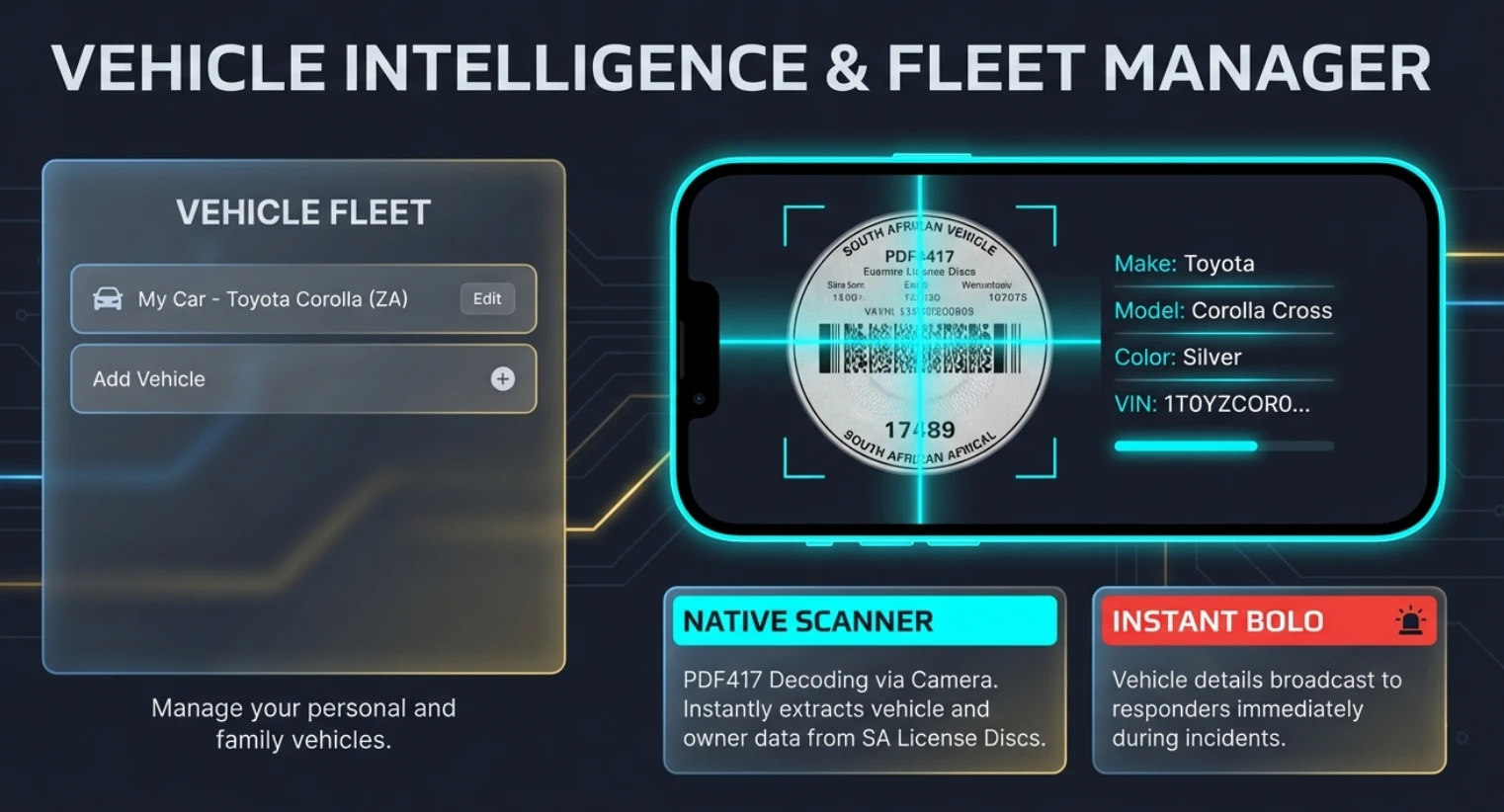
Vehicles work the same way. In a hijacking, the first details police and responders need are the vehicle’s make, model and colour. Guardian captures these in advance by scanning the barcode on a South African licence disc, so make, model, colour and VIN are ready the moment an incident opens.
Warnings matter too. Operators can flag a client with a permanent note that every other operator sees: a vicious dog on the property, venomous animals, a history of repeat false alarms. A responder who knows about the dog before opening the gate is a responder who goes home safely.
- Critical medical record: blood type, medical aid, chronic conditions, allergies and medication.
- Emergency contacts the control room can reach.
- Vehicle make, model, colour and VIN, captured from the licence disc.
- Client flags: animals on the property, repeat false alarms and other warnings.
Silent alerts need a different playbook
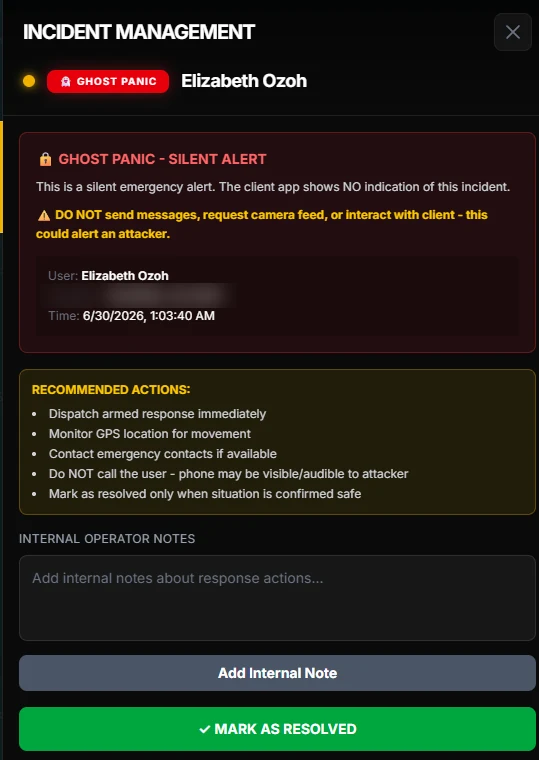
Standard procedure says verify before dispatch, and for most alerts that is right. For a silent alert it is exactly wrong. A subscriber who chose a silent alarm did so because someone is watching them. A call back, a text message or a request for video can be seen or heard, and tells the attacker that help has been called.
Guardian treats Ghost Panic alerts differently on screen. The incident is labelled as a silent alert, the operator is told the subscriber’s app shows no sign of it, and the recommended actions are explicit: dispatch armed response immediately, watch the GPS position for movement, contact emergency contacts if available, do not call the user, and resolve only once the situation is confirmed safe.
WSN note:Write your silent-alert procedure down and train it. The instinct to phone the subscriber is strong, and in a silent alert it is the wrong instinct.
From acknowledgement to resolution
Once the operator knows enough, the workflow should be simple and the same every time. Guardian follows four steps, and each is recorded with the time and the operator who took it.
- 01Acknowledge: the audio alarm stops and the operator’s name is logged against the incident.
- 02Dispatch: the operator selects a team, and the incident shows who was sent and by whom.
- 03Update: the subscriber receives messages in the app, so they know help is coming. Silent alerts are the exception.
- 04Resolve: the incident closes and moves into the history, where notes can still be added afterwards.
After the incident
An incident is not finished when the vehicle leaves. Somebody will ask what happened: the subscriber, a family member, an insurer, the police or a regulator. The answer should not depend on an operator’s memory.
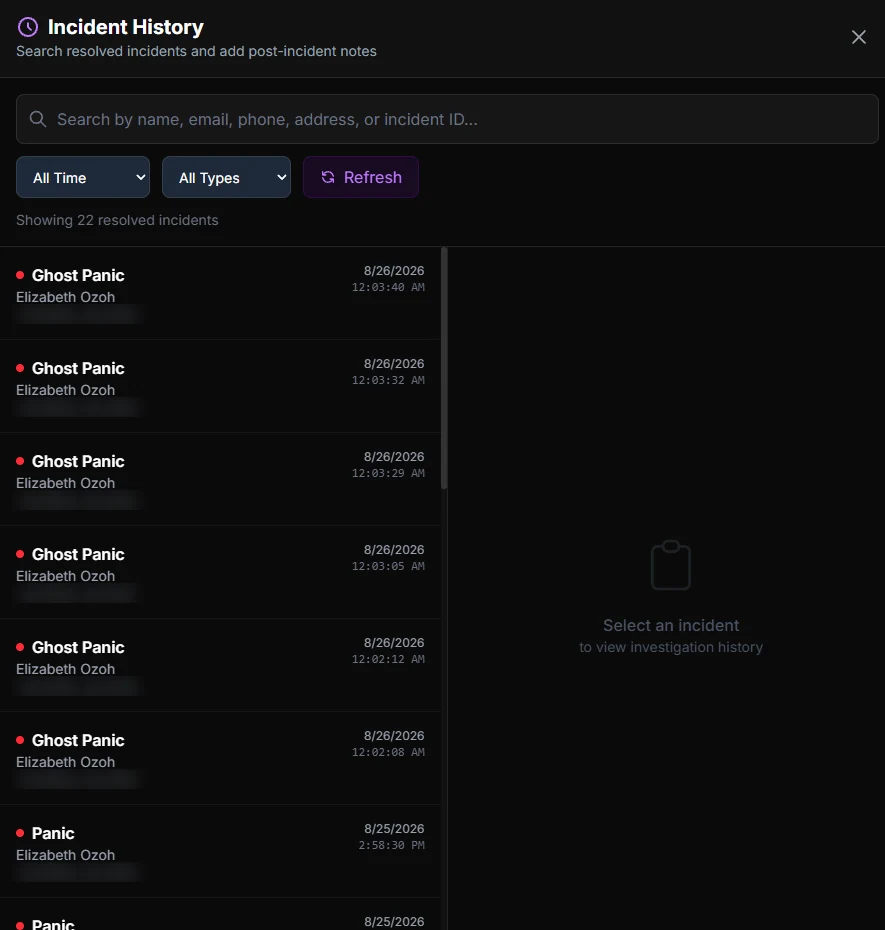
Guardian keeps resolved incidents in a history that can be searched by name, email, phone, address or incident ID, where operators can add post-incident notes. Shift handover notes carry context from one shift to the next, and an audit trail records each dispatch, acknowledgement and resolution with the time and the person responsible. The audit trail can be filtered and exported as a report.
Common questions
Should operators always phone the subscriber to verify an alert?
For most alerts, verification is good practice. For silent alerts it is not, because a call can be seen or heard by an attacker. Your procedure should say clearly which alerts are verified and which are dispatched straight away.
How accurate is phone location?
It varies with the phone, the surroundings and the signal. Outdoors it is usually good; inside buildings and between tall structures it is less precise. That is why an accuracy estimate and street-level views matter, and why a stored address is still useful as a reference.
Can the control room see live video?
Guardian can stream live video from the subscriber’s phone to the control room during an incident, where the situation allows it. During a silent alert, operators are told not to request it, because the request could alert an attacker.
What is a client flag?
A permanent warning on a subscriber’s profile that every operator sees, such as a vicious dog on the property or a history of repeat false alarms. It means the next operator and the next responder know what the last one learned.